Quick Summary
- Write the viewer's question and your video's actual answer before drafting a title.
- Choose a searchable, curiosity-led or hybrid angle according to how someone might discover the video.
- Keep the topic recognizable; put branding and episode labels after the useful information.
- Make the title, thumbnail and opening deliver one consistent promise.
- Review clicks alongside viewing behavior and traffic source before deciding what to change.
Build your YouTube title strategy around five decisions: identify the viewer, choose one promise, check the evidence, align the title with the thumbnail and opening, then review the audience response. A useful title makes the subject and reason to watch clear while promising only what the finished video delivers.
This guide is for creators publishing Tamil, Tanglish or English videos. It connects the viewer's need to the promise, supporting evidence, finished package and lessons for the next upload. All examples below are illustrative writing exercises, not tested titles or claims about real channel performance.
YouTube title guide: choose your starting point
| Your immediate task | Read next | What you will finish |
|---|---|---|
| Make the words and image work together | Title and thumbnail strategy | A coordinated pair with an identifiable promise |
| Turn an outline into several titles | YouTube title formulas | Variants that fit your video format |
| Publish a new channel's first upload | Your first YouTube video title | A title that makes sense to a stranger |
| Package a short answer or moment | YouTube Shorts title strategy | A title with enough context for feed and search |
Start with the decision blocking your next video. If you know the subject but cannot divide the message between words and image, the title and thumbnail strategy guide walks through coordinated examples. If you need different ways to express a finished idea, the YouTube title formulas help you choose structures that fit the format.
New creators can work through the first-video title worksheet to make their promise understandable to a stranger. For a short demonstration or moment, the Shorts title strategy guide explains what the title needs to communicate alongside a video that may already be playing in the feed.
What does a useful title need to communicate?
A viewer should be able to identify the subject and a reason to watch. The subject might be phone storage, dosa batter or a train journey. The reason might be a fix, a demonstrated result, a comparison or an unfolding story.
“Phone Tips” names a category. “Phone Storage Full? Check These 3 Folders” names a problem and a bounded answer. The second is more specific only if the video actually checks three folders and explains what is safe to remove.
Before drafting, complete the sentence below with a viewer, outcome and supporting material you can identify. If one of those parts is missing, clarify the video idea before polishing its wording.
This video helps [specific viewer] understand, do or experience [specific outcome] using [the demonstration, evidence or story I have].
Searchable, curiosity-led or hybrid: which should you choose?
Choose a searchable title when the viewer needs a recognizable answer, a curiosity-led title when a concrete situation or story creates the interest, and a hybrid when both help explain the video. YouTube distinguishes searchable titles from intriguing titles; the right choice depends on what this viewer is looking for or would find worth exploring.
| Approach | Viewer situation | Illustrative title | What must be in the video |
|---|---|---|---|
| Searchable | Looking for an answer | How to Free Phone Storage Without Deleting Photos | A demonstrated process with its limitations |
| Curiosity-led | Interested in an experience | I Tried Filming a Vlog Without Checking the Screen | The experiment and what happened |
| Hybrid | Recognizes a problem and wants a reason to care | Phone Storage Full? The Folder I Forgot to Check | The relevant folder and a safe explanation |
These are editorial choices, not fixed rules for niches. A travel channel can publish a searchable route guide and a curiosity-led journey. A cooking channel can teach a recipe or document a failed experiment. Do not assume a new channel can only receive search traffic. Choose the wording that makes the video's value understandable without prior knowledge of you.
Build your YouTube title strategy: audience, promise and proof
1. Define the audience more narrowly than the niche
“Tech viewers” is broad. “People who need space on an Android phone but want to keep family photos” creates a useful writing constraint. For a Tamil education video, decide whether you are speaking to a beginner learning a concept or a student revising it. The same topic can require different promises.
2. Pick one promise
List everything in the outline, then choose the strongest outcome the finished video can deliver. A video might discuss storage settings, cloud backups and duplicate files. That does not require a title listing all three. It may need one clear outcome, followed by the most important qualification.
3. Identify the proof
A title about a test needs a test. A title about a cost needs the relevant receipts or calculation. A title about a transformation needs an honest starting point and result. Use “I tried” when you tried it. Use “explained” when you are explaining it. Do not turn a summary of other people's reviews into your own hands-on experience.
4. Write different angles
Draft a direct answer, a question and a concrete observation so you can compare different reasons to watch. Three synonyms for “amazing” keep the same vague promise; a useful variation changes the angle while remaining faithful to the footage.
5. Align the video title with the thumbnail and opening
Read the title beside the thumbnail and first spoken line. A viewer should encounter the same subject and expectation in all three. Our paired-example guide shows how to divide the information.
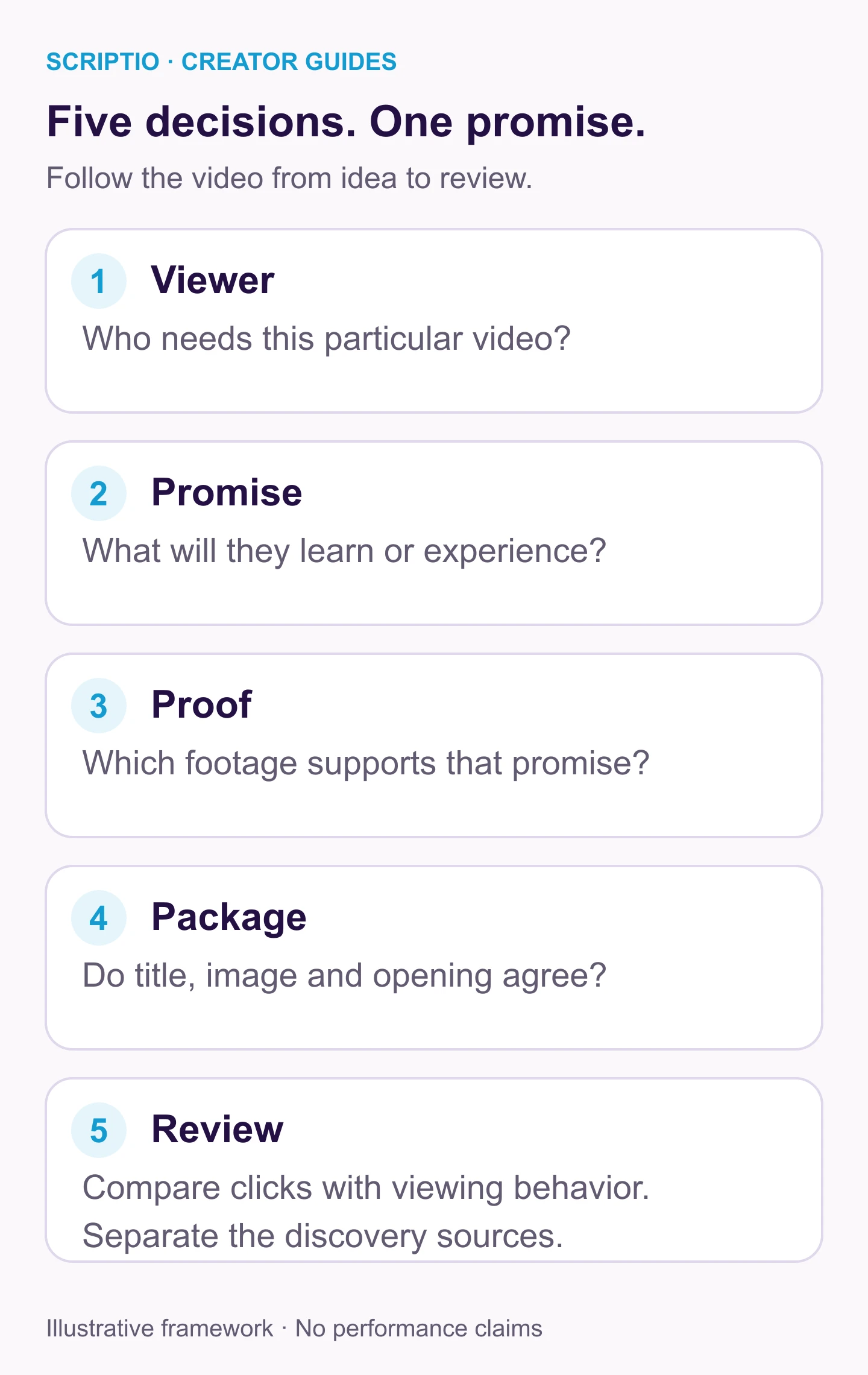
Use this sequence to check the promise before polishing the words. The review feeds into your next video idea, rather than turning one result into a universal title rule.
Worked example: one topic, three honest options
Imagine a Tamil tech creator has recorded a screen demonstration checking three storage locations. The creator has not measured a universal amount of storage saved. The viewer is someone whose phone is nearly full, and the promise is to find storage worth checking before deleting personal photos. The proof consists of screen recordings, settings explanations and a warning about files that should be retained. These three details support the following title options:
- Direct: “Phone Storage Full? Check These 3 Folders.”
- Question: “Photos Delete Pannama Space Kidaikkuma?”
- Hybrid: “Phone Storage Full? Photos Delete Pannama Check Pannunga.”
The second Tanglish title means “Can you get space without deleting photos?” It needs the thumbnail or opening to clarify the subject. The hybrid supplies that context in the title. Reject “Get 20 GB Free Instantly” unless that specific result is demonstrated and its conditions are clear. Even one device achieving the result does not establish that every viewer will.
How should Tamil creators choose title language?
Begin with the words the intended viewer recognizes. Keep product names and technical terms legible. Decide whether Tamil script, Romanized Tamil or English makes the task easiest to understand. For this storage tutorial, each language option keeps the phone problem recognizable and identifies the same three checks. Compare the wording below with the way your intended viewers discuss the topic, rather than assuming a direct translation will always sound natural:
- Tamil script: “போன் ஸ்டோரேஜ் நிரம்பிவிட்டதா? இந்த 3 இடங்களைப் பாருங்கள்.”
- Tanglish: “Phone Storage Full? Indha 3 Idangalai Check Pannunga.”
- English with context: “Phone Storage Full? 3 Places to Check | Tamil.”
These are options to evaluate, not a claim that one language ranks better. Romanized spelling varies; clarity matters more than choosing a supposedly perfect transliteration. Check the phrases people use in your comments and, where available, your YouTube search-term reports. A broad keyword estimate for India does not prove the exact wording your own Tamil audience prefers.
YouTube title best practices: length, keywords and labels
YouTube's video-settings documentation gives a 100-character title limit. That is a technical ceiling, not a target to fill. Preview the title in a narrow layout and check whether the subject remains recognizable before the text is cut off. Remove filler before removing an important qualification; a software version or “for beginners” may be more useful than your episode number.
Use a keyword to name the actual video topic naturally. Repeating “Tamil tutorial Tamil tips Tamil video” makes the title harder to read without adding a useful distinction. YouTube Search considers relevance, engagement and quality, so including a phrase is only one part of relevance and does not guarantee a ranking.
What should you measure after publishing?
Review impressions, clicks and viewing behavior together, separating traffic sources before deciding whether the title needs work. A small decision log helps you connect an observation to a specific hypothesis instead of reacting to every fluctuation or blaming wording for every weak result.
| Observation | What to inspect | Sensible next step |
|---|---|---|
| Few impressions | Topic fit, discovery source and video visibility | Do not conclude that the title alone is responsible |
| Impressions but weak clicks on a relevant surface | Promise clarity and thumbnail readability | Develop a specific packaging hypothesis |
| Clicks followed by early exits | Opening, pacing and promise mismatch | Fix the mismatch in the next video; review current packaging |
| Different results by traffic source | Search intent versus browsing interest | Compare like-for-like sources |
YouTube explains how registered thumbnail impressions lead to views and watch time. Keep that distinction in mind when comparing metrics. Where your channel and video are eligible, YouTube Studio offers native title and thumbnail A/B testing. Use a title-only test when the question concerns wording; changing the entire package tests the package. Keep a record of what changed and avoid attributing a result to one word when several things changed.
Frequently asked questions
What are the best YouTube titles?
The best title for your video makes its subject and reason to watch clear to the intended viewer. A tutorial needs a recognizable task; a story needs a concrete situation or tension. There is no title pattern that guarantees views.
What makes a title catchy without becoming clickbait?
A catchy title highlights a real contrast, useful result or unanswered question. It becomes misleading when the video cannot deliver the implied promise. Check the title against the footage and conclusion before uploading.
How do I title YouTube Shorts?
Name the specific moment, answer or result in the Short. Make the opening communicate that same promise. Keep the title readable in search and on channel pages; a title alone cannot solve viewers swiping away.
Build a title you can defend
Take your next finished outline and write down its audience, promise and proof. Use the format-specific title formulas to draft different angles, then compare each with the thumbnail and opening. Keep the option you can defend: who it is for, why they might watch and exactly where the video delivers that promise.
Write your next script in 60 seconds.
Scriptio writes a full Tanglish script in your exact voice, built from your own channel.
Explore the Tamil AI script writer or the Tanglish script generator for a more detailed walkthrough.
Start Free at Scriptio.in