TL;DR
- Voice DNA analyzes a creator's own channel only. No second or inspiration channel is collected at any plan level.
- Onboarding is 2 steps: channel search, then niche selection.
- Free analyzes 9 videos, Creator analyzes 14, Pro analyzes 20 (recent videos plus top-performing videos combined).
- Script generation runs 4 stages: Voice DNA, research, writing, polish. The script saves immediately after.
- GEO and SEO metadata generation is a separate step that runs after the script opens in the editor, not before saving.
- Voice DNA tracks hook style, Tanglish ratio, sentence rhythm, regional dialect, address style, signature phrases, transitions, and CTA delivery.
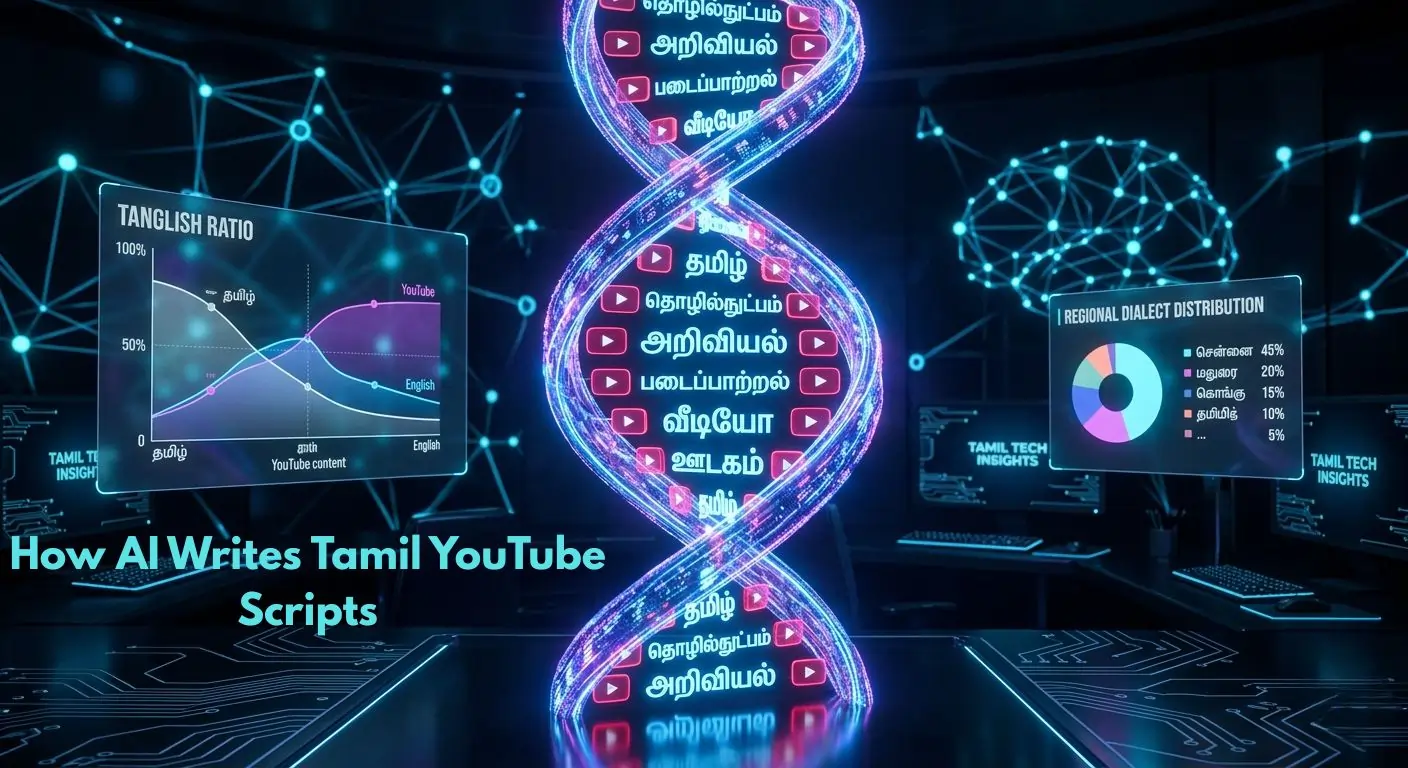
How does AI write Tamil YouTube scripts that sound like a specific creator? Scriptio calls this process Voice DNA. It studies a creator's own uploaded videos, measures exactly how they speak on camera, and writes every new script inside that same pattern instead of a generic one.
Ask ChatGPT for a Tamil YouTube script and it hands back something correct on facts and wrong on delivery. It does not know your Tanglish ratio. It does not know your dialect. It does not know the phrase your subscribers wait for before every new section.
This post explains exactly how the engineering behind Voice DNA closes that gap.
What Are Tamil Creators Actually Saying About AI Script Tools?
Search "Tamil YouTube script" on Reddit or in any Tamil creator Facebook group and the same five complaints repeat.
"I gave ChatGPT my topic and it wrote something that sounds like a news anchor trying to speak Tamil."
"My views are stuck at 200 per video even though the information is correct. I don't know if it is the scripting."
"I spend 5 to 6 hours writing one script. By the time I finish, I am too exhausted to record it properly."
"The AI script sounds too formal. Reading it on camera feels like presenting a report, not talking to my audience."
"I tried copying a bigger creator's style and it comes out wrong. It sounds like an impression, not me."
These are the most common complaints from Tamil creators between 500 and 50,000 subscribers. Every generic AI script generator they try produces output that is too English, too formal, or disconnected from how they actually talk on camera. Regional language content now reaches the overwhelming majority of India's internet base, not a fringe of it, according to the joint IAMAI and Kantar Internet in India report. Creators who want to see the difference by hand first can try the free Tanglish template before Voice DNA takes over the process. If the category itself is new to you, start with the plain-English primer on what a Tamil AI script writer actually is.
Why Does Generic AI Get Tamil Scripts Wrong?
Generic AI was trained on average internet text, so it writes average language that sounds like no Tamil creator in particular.
A Tamil creator's on-camera speech is a linguistic pattern built over years of talking to one specific audience. It is not improvised. It is a set of habits an audience has learned to recognize and expect. Language on Indian YouTube has shifted from a barrier into a feature, according to a Google blog review of the platform's biggest 2025 trends, and that shift rewards creators who lean into their own dialect rather than flatten it.
Feed that same creator's topic into a generic AI tool and the output is technically correct and completely wrong on delivery. Delivery is the entire job of a YouTube script.
Scriptio does not start writing until it has studied who the creator is on camera. That study process is Voice DNA, and it is why the output sounds like a specific person instead of a translated English script with Tamil words dropped in at random. A full side-by-side sits in the Tamil AI scriptwriter vs ChatGPT comparison.
How Does the 2-Step Onboarding Work?
Onboarding takes two steps: search for the channel, then pick a niche. There is no third step.
Step 1: Find the YouTube Channel
The creator searches for their own channel by name. Scriptio pulls the real channel data straight from YouTube, including subscriber count and handle, so the analysis is built on verified content rather than a manual entry that could be wrong.
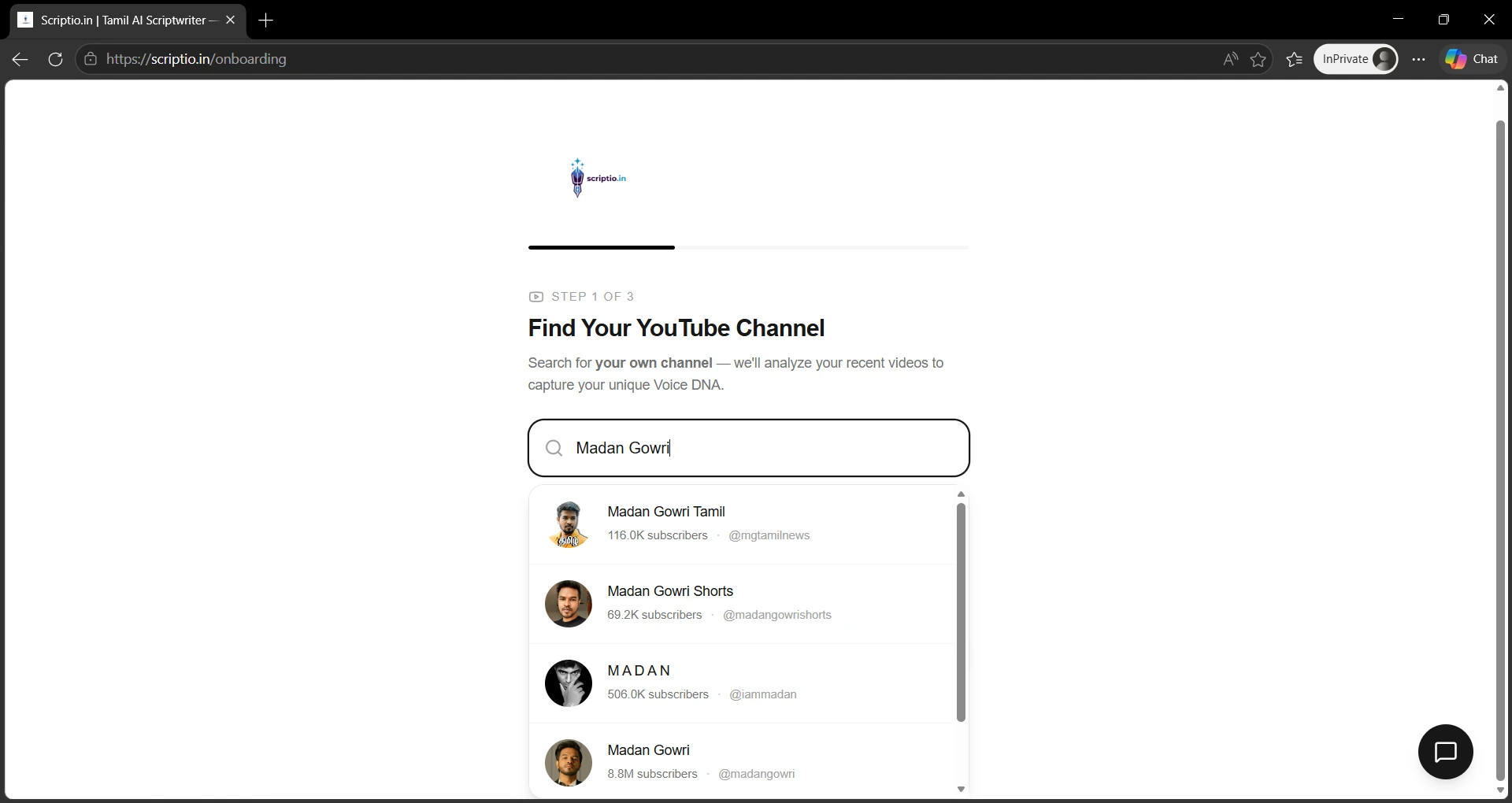
Search the channel by name. Scriptio pulls live subscriber data directly from YouTube so Voice DNA is built on verified content.
Step 2: Define the Niche
The creator selects the category that best describes their content: Tech Reviews, Food and Cooking, Travel and Vlogs, Education, Entertainment, Finance and Business, Health and Fitness, Gaming, Lifestyle, News and Commentary, or Other.
This is not a cosmetic label. Niche tells the engine which language patterns and topical vocabulary to expect, so the Voice DNA analysis is calibrated to the right creative context. A Finance creator's Tanglish patterns look nothing like a Gaming creator's, even from the same city.
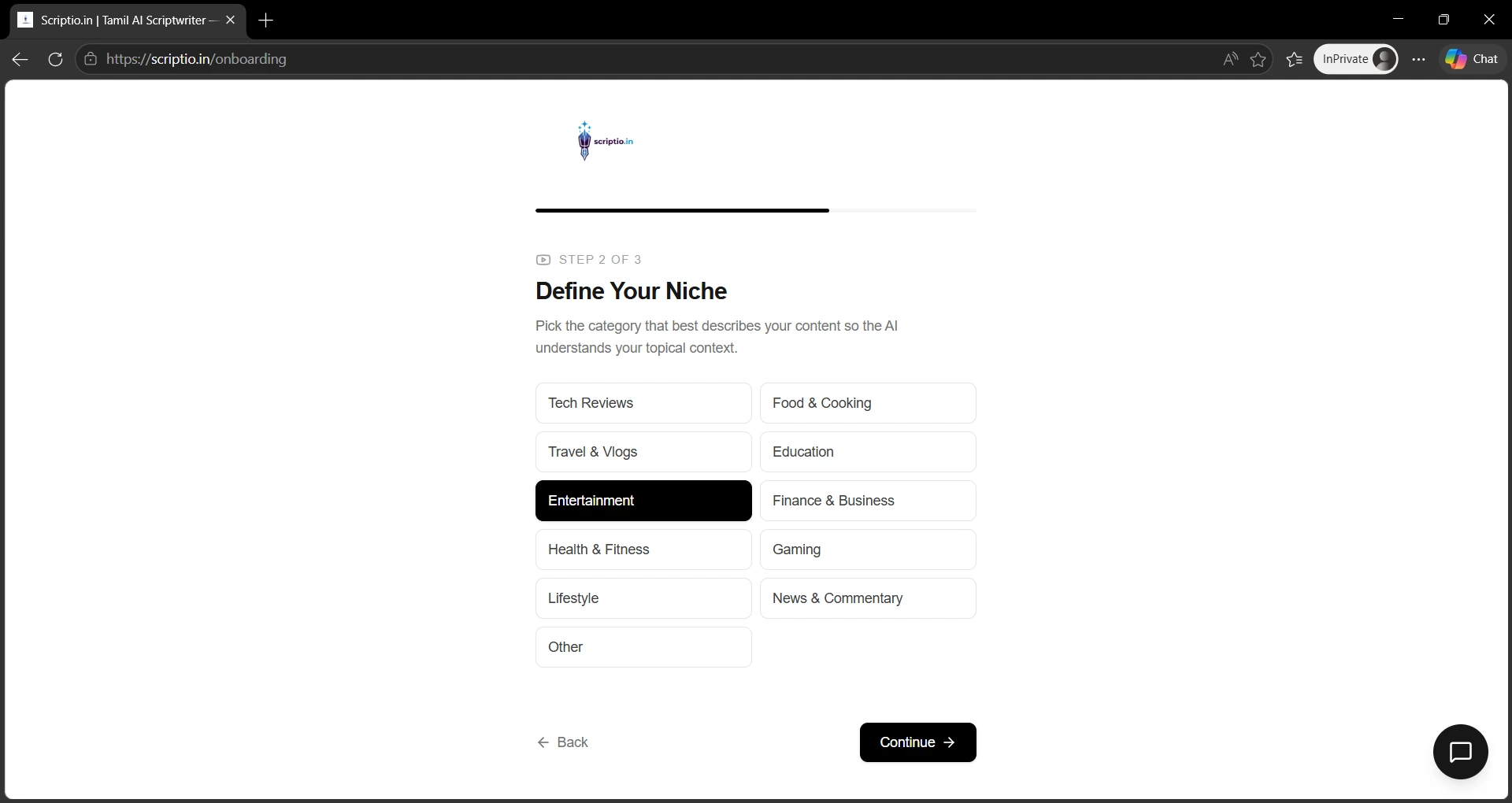
Pick the category that matches the content. Niche tells the engine which language patterns to expect before Tanglish ratio analysis starts.
Failure mode: a channel with almost no uploads still completes onboarding, but the profile stays shallow until more videos exist to analyze. Choosing the closest matching niche, even for a mixed-content channel, keeps the calibration honest.
What Happens After Onboarding Completes?
Once the channel and niche are confirmed, Scriptio begins extracting Voice DNA from that channel's own videos.
The extraction screen shows exactly which channel is being processed, so the creator can confirm the right profile before it locks in. Once extraction finishes, the Voice DNA profile saves, and every script generated after that uses it automatically.
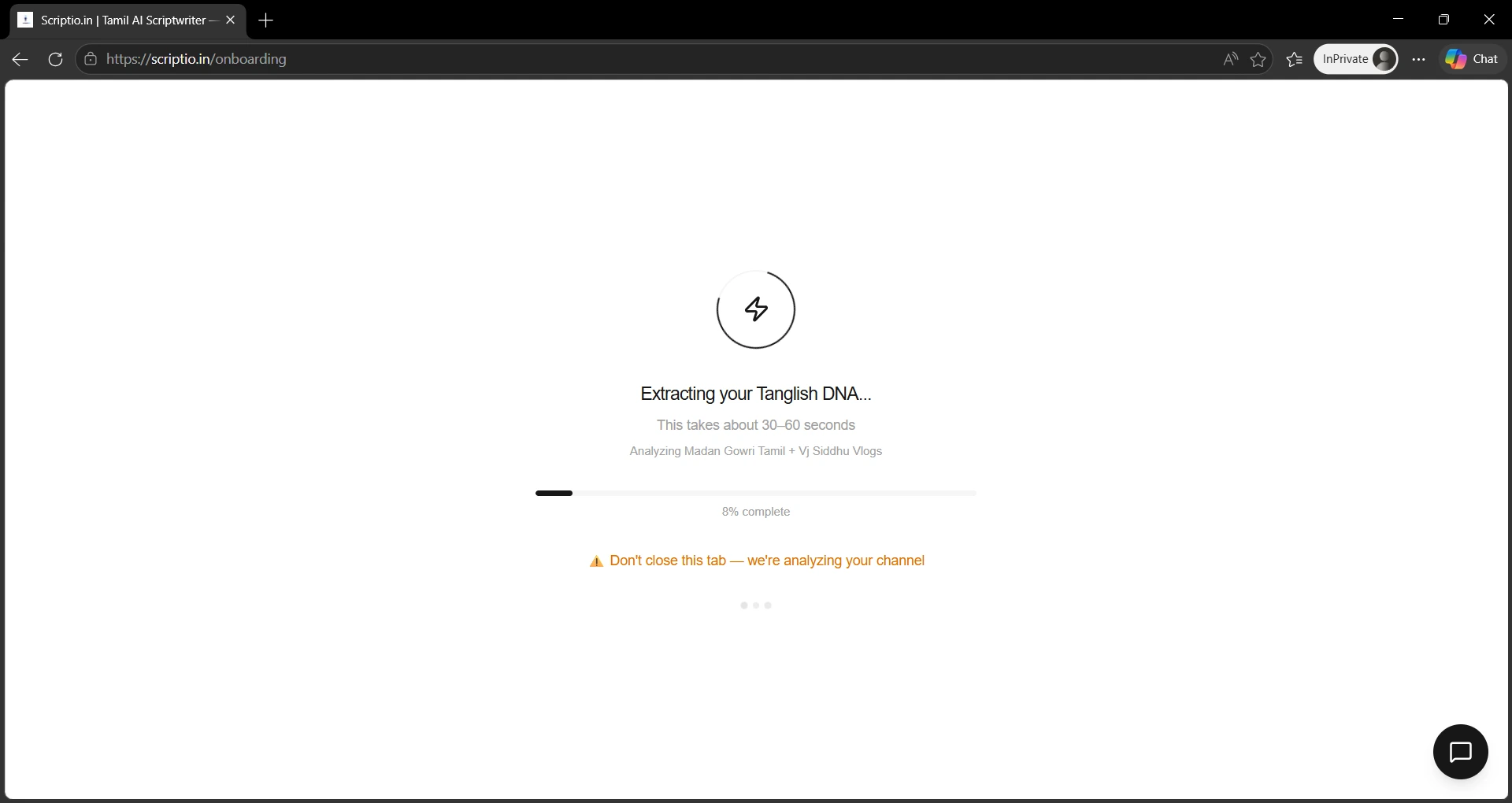
The creator's own channel gets analyzed in one pass. The screen confirms which channel is processing before the profile locks in.
What Does Voice DNA Actually Analyze From a Creator's Videos?
Voice DNA extracts eight specific creative fingerprints from a creator's own uploaded videos.
1. Hook Architecture
The first 30 seconds decide retention. Voice DNA identifies the dominant hook style: a direct statement, a question to the audience, a personal story, or a bold claim. It also measures how long the hook runs before the main content starts. Some creators take 20 seconds. Some take 90. Voice DNA captures that timing and writes every new hook to match it. Creators curious about their current hook pattern can run it through the free hook analyzer first.
2. Tanglish Ratio
This is the variable no generic tool even attempts to measure. Tanglish is not random mixing of Tamil and English. It follows rules a creator has internalized without ever naming them.
Technical vocabulary tends to stay in English because the Tamil equivalent sounds unnatural. Emotional language shifts to Tamil because it lands harder. Humor almost always delivers in Tamil, because comedic timing breaks in translation. Instructions and calls to action swing back to Tanglish, because they need to register instantly.
An IAMAI and Nielsen study found that 68 percent of Indian internet users prefer content in their native language, and the gap between a script that respects that pattern and one that ignores it shows up directly in watch time.
| Metric | Figure | Source |
|---|---|---|
| Tanglish mix across niches | 54% Tamil (finance) to 94% Tamil (devotional) | Scriptio, 119-channel Tanglish study, 2026 |
| Indian users preferring native-language content | 68% | IAMAI and Nielsen, 2024 |
A creator whose real ratio sits near the finance end of that range gets a script written differently from one whose ratio sits near the devotional end. Scriptio's Tanglish ratio study breaks the full 119-channel dataset down by niche.
3. Sentence Length and Rhythm
Short punchy bursts that land one point at a time. Long sentences that carry a full thought before the punchline. A shift between fast and slow delivery depending on tension. Voice DNA calculates average sentence length, the variance between shortest and longest constructions, and how pacing shifts between informational and emotional moments.
4. Regional Dialect Markers
No two cities speak the same Tanglish.
A Chennai creator drops phrases like "enna da scene," "machaan kelu," "super-a irukkum." The rhythm runs fast, the humor lands in short sharp bursts.
A Coimbatore creator sounds different. Kongu dialect brings "enna-ba," "super-ba solren," "konjam listen pannu-ba." The pacing runs slower and warmer.
A Madurai creator has a signature entirely their own: "semma scene-da," "enna kaila kekkura," "athu correct dhaan." The delivery carries more assertive energy.
What Voice DNA is detecting here are terminal particles, the sounds that attach to sentence endings and signal region and relationship. The "-ba" that marks Kongu Tanglish. The "-da" that runs through Madurai speech. These are automatic, not conscious choices, and a script that gets them wrong feels slightly off even when the creator cannot say exactly why.
5. Audience Address Style
"Neenga" for respect. "Ungaluku" for warmth. "Guys" for a younger, English-forward audience. "Dai" for casual camaraderie. Each carries a distinct relationship. Voice DNA captures the exact address pattern a creator already uses so every generated script keeps that same relationship tone.
6. Signature Phrases
Three words, every video, and an audience is in. That is what a strong signature opener does. It is a brand signal and a production value at once. Voice DNA identifies a creator's version of this, whether it is an opening line, a transition phrase, or a closing line the audience already anticipates, and carries it through instead of replacing it with generic filler.
7. Transition Language
A recap before moving forward. A hard cut with a single phrase. A repeated bridge an audience recognizes as the signal for the next section. Voice DNA tracks these patterns and replicates them in the script structure.
8. CTA Delivery Style
Direct asks. A CTA folded into a joke. The same line every video until it becomes a running bit with the community. Voice DNA captures that energy so the closing 30 seconds of a script does not sound like a different person took over.
What Steps Does Scriptio Run Before a Script Is Ready?
Script generation runs four tracked stages: Voice DNA, research, writing, polish. The script saves the moment those four finish.
Stage 1: Voice DNA
The creator's stored Voice DNA profile loads and becomes the filter for everything written next. Hook style, Tanglish ratio, dialect markers, and address pattern all become the operating layer for generation.
Stage 2: Research
Scriptio pulls current information related to the video topic, so the script reflects recent context rather than outdated facts.
Stage 3: Writing
Hook, body, transitions, and CTA get written inside the Voice DNA profile, structured around the topic and any direction the creator gave.
Stage 4: Polish
The draft gets refined for flow and consistency against the Voice DNA constraints before the script is marked complete.
The script saves to the Script Library the moment polish finishes. GEO and SEO metadata generation is a separate step. It fires when the creator opens the script inside the editor, reformatting specific parts of the text to improve the odds of getting cited by AI engines like ChatGPT, Perplexity, and Google AI Overviews. Saving does not wait on it.
How Long Does Script Generation Actually Take?
Generation time scales with script length, from under 30 seconds for a Short to roughly 4 minutes at the outer edge for a 30-minute script.
| Script length | Typical generation time |
|---|---|
| 30s to 1:30 (Shorts) | Under 30 seconds |
| 3 minutes | Under 1 minute |
| 5 minutes | 20 to 60 seconds |
| 10 minutes | 1 to 2 minutes |
| 15 minutes | 1.5 to 2.5 minutes |
| 20 minutes | 2 to 3 minutes |
| 30 minutes | 2.5 to 4 minutes |
| Any length, thin Voice DNA | 1 to 3 minutes |
| Any length, worst case with retries | Up to roughly 4 minutes |
The four stages stay fixed regardless of length. What changes is how much the writing and polish stages have to produce, so a 30-minute script runs the same pipeline as a Short, just for longer. A thin Voice DNA profile, one built from very few videos, can also add time, since the writing stage has less signal to lock onto early.
Why Does 20 Videos Produce a Fundamentally Different Script Than 9?
Analyzing 20 videos instead of 9 changes profile accuracy, and that accuracy shows up in every script the profile generates.
| Feature | Free | Creator | Pro |
|---|---|---|---|
| Recent videos analyzed | 6 | 10 | 14 |
| Top-performing videos analyzed | 3 | 4 | 6 |
| Total videos analyzed | 9 | 14 | 20 |
| Regional dialect detection | Limited | Reliable | Full |
| Price | Free | ₹399 first month, then ₹999/month | ₹1,999/month |
Recent videos show who a creator is right now. Top-performing videos show who they are at their most precise, the version of themselves that already worked on their own audience. The jump from Free to Creator is where dialect accuracy becomes reliable. The jump from Creator to Pro is where the profile has enough range to tell a tutorial apart from a reaction video in the same voice. Full plan details sit on the Scriptio pricing page.
What Does Generic AI vs Voice DNA Output Actually Look Like?
The difference between a generic AI script and a Voice DNA script shows up in the first line.
A generic AI script generator output for a Tamil tech creator: "Hello everyone, today I am going to discuss five artificial intelligence tools that can help improve your daily productivity."
Read that in the voice of any Tamil creator with a real audience. It does not fit.
A Voice DNA script for the same creator, built from their own Madurai-based channel: "Dei. Enna panna poren nu theriyuma? Ungala indha week full-a lazy aakka vaikkura 5 tools introduce pannaporene. Nee already YouTube shortcuts thedi thedi thirinjunu theriyum. So direct-a poalam."
That opening is not a translation. It is shaped by that specific creator's hook style, Tanglish ratio, Madurai dialect markers, and address pattern, extracted from their own videos. The first line could have been written for anyone. The second could only have been written for that creator, the same gap covered in the Scriptio vs Claude breakdown.
Can Voice DNA Be Re-Blended as a Creator's Voice Changes?
Pro and the Founder's Pass include Style Mixer, which lets a creator manually re-weight their own Voice DNA profile.
The way a creator opened videos at 500 subscribers is not how they open them now. Tanglish ratio shifts as an audience grows. Signature phrases evolve.
Style Mixer lets a creator weight recent videos more heavily against top-performing ones, or rebuild the profile from scratch after a content direction change. The engine grows with the creator instead of staying fixed on who they were months ago.
But Is Voice DNA Perfect?
Fair question, and the honest answer is no.
Any AI script generator claiming a flawless first draft should raise doubt. Voice DNA gives a starting point already calibrated to a creator's own patterns. A creator will still read the script before recording and still adjust a phrase or two before it feels right in their mouth.
The difference is that those tweaks take a few minutes, not the 5 to 6 hours the scripting process used to eat from the week. The job shifts from writing from scratch to reviewing and refining, and that shift is the actual value of Voice DNA.
Ready to See a Voice DNA Script Built From an Actual Channel?
5 free credits every month, no credit card. A Voice DNA profile built from a creator's own channel, and a first Tamil YouTube script ready in as little as 30 seconds for a Short, a few minutes for a full-length video.
Frequently Asked Questions
I am from Coimbatore and every AI script sounds like it was written for a Chennai creator. Will Voice DNA fix this?
Yes. Regional dialect detection is one of the specific signals Voice DNA extracts from a channel's own videos. Kongu Tanglish markers get captured in the profile and preserved in every script output, so a Coimbatore creator should not receive scripts written in a Chennai rhythm.
My channel has very few videos. Will the AI script generator still work?
It will, though the profile stays shallow until more uploads exist. A small handful of videos is enough to build a base profile. Uploading more and rebuilding the profile afterward improves dialect and rhythm accuracy significantly.
Do I need to search for a second or inspiration channel during onboarding?
No. Onboarding is 2 steps at every plan level: channel search, then niche selection. Voice DNA is built from a creator's own channel only, and no second channel gets collected during setup.
How is this different from writing a detailed prompt in ChatGPT?
A detailed prompt tells an AI what to write. Voice DNA tells Scriptio how a specific creator writes. Prompt output is only as good as a creator's ability to describe their own voice in words. Voice DNA extracts that voice directly from their actual videos instead.
Will the Tanglish ratio in my script match what I use on camera?
That is exactly what Tanglish ratio analysis measures. A channel that runs 60 percent Tamil and 40 percent English across its videos gets scripts written in that same ratio, not a generic 90 percent English draft.
Does GEO optimization happen before or after my script saves?
After. The script saves the moment the four generation stages finish. GEO and SEO metadata generation runs separately, triggered when the script opens inside the editor.
Does Voice DNA work for Shorts or only long-form scripts?
Both. Short-form scripts use a compressed version of the hook and CTA patterns. Long-form scripts use the full pacing and transition architecture. The same profile powers both, calibrated to the length selected at generation.
About the Author
Prathap is a content strategist and digital marketer based in Chennai. He holds a B.Tech in Agricultural Engineering and completed the Master Content Writing program at IIM SKILLS. He built Scriptio after months of researching why Tamil YouTube creators were struggling with scripting despite having real ideas worth sharing. He also runs ourkitchen.in, a kitchen appliance review site built for Indian households. Connect with him on LinkedIn: https://www.linkedin.com/in/prathap-scriptio/
Write your next script in 60 seconds.
Scriptio writes a full Tanglish script in your exact voice, built from your own channel.
Explore the Tamil AI script writer or the Tanglish script generator for a more detailed walkthrough.
Start Free at Scriptio.in